Hot Dip Galvanizing Equipment Compliance: HCl, Zinc Smoke and Waste Acid Limits Explained
Environmental approval is now the longest item on most galvanizing project schedules — longer than fabrication, longer than shipping. A hot dip galvanizing plant produces three regulated streams: acid fume from pickling, zinc smoke from the kettle, and waste acid from the baths. Each has a number attached to it, and each number has an equipment answer. Here is how the reference line from Xinlingyu is engineered to meet them.
Stream 1: Acid Fume — HCl Below 100 mg/m³
Pickling releases hydrogen chloride, and the permit limit is usually expressed two ways: concentration and mass flow. The reference line holds HCl in treated tail gas below 100 mg/m³ with an emission rate under 0.43 kg/h, discharged through a 20 m chimney.
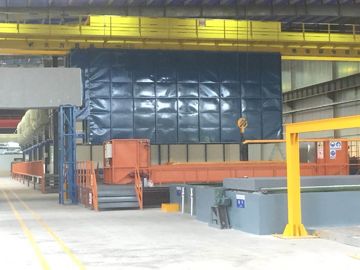
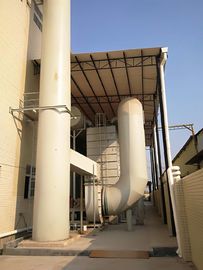
The engineering that gets there is a closed fume room (61.0 × 3.8 × 6.5 m on the reference layout) feeding two PP washing towers in series. The first tower sprays water, washing out roughly 80% of the acid fume and producing dilute hydrochloric acid that is reused for rack cleaning — the same acid then reacts with zinc residue on the racks to form zinc chloride, which is a usable flux component. The second tower neutralizes the remainder with alkaline spray before discharge. Fume capture in the room is designed to 95%, with induced draft maintained by a 25,000 m³/h FRP fan at 2,400 Pa.
Stream 2: Zinc Smoke — 95% Capture, Particles Below 90 mg/m³
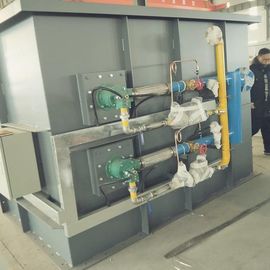
Every dip into the kettle produces metal fume. The reference design uses a closed stainless hood with observation windows at working height and electric doors at both ends; an induced draft fan holds the hood under negative pressure so nothing escapes when the workpiece enters. Capture efficiency exceeds 95%, solid particles in the exhaust stay below 90 mg/m³, and blackness reaches grade 1.
| Zinc Smoke Control Parameter | Reference Value |
|---|
| Air handling capacity | 60,000 m³/h |
| Filter area | 1,100 m² |
| Filter velocity | 1.0 m/min |
| Equipment resistance | 1,200–1,500 Pa |
| Negative pressure | 5,000 Pa |
Stream 3: Waste Acid and Wastewater — Closed Loop, Not Drain
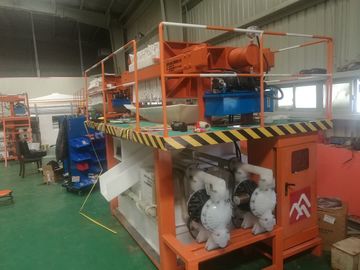
Spent pickling acid and rinse water are routed to an acid waste neutralization system, where pH is corrected and the neutralized water is returned to production as make-up rather than discharged. The process is also designed without a water-washing stage, which removes an entire rinse circuit from both the investment and the daily operating cost. For flux, online regeneration handles up to 4 m³/h, holding iron ions below 2 g/l at pH 3.0–4.5 with a filter area of at least 30 m² — keeping iron out of the zinc and cutting dross and zinc consumption.
Why Compliance Equipment Pays for Itself
- Acid recovery: the first scrubber tower produces reusable HCl and, through the rack reaction, usable flux — abatement with a product stream.
- Flux regeneration: lower iron in the flux means less zinc lost to dross, the single largest consumable cost.
- No water-wash stage: less capex, less water, less effluent to treat.
- Waste heat recovery: flue gas holds the flux bath at 60–70 °C, cutting fuel use by roughly 10%.
Permits differ by jurisdiction — EU BAT conclusions, US NESHAP, and provincial rules in Canada each phrase the limits differently — but the equipment set is remarkably consistent: closed capture, two-stage scrubbing, bag filtration, neutralization and regeneration. Send your local permit limits and the engineering team will map the equipment scope to the numbers you must meet.


 Your message must be between 20-3,000 characters!